


Cheers to Chairs
- Shelley Bakker

- Feb 16
- 6 min read
Recycling and Repurposing
I have a passion for art, design and for the last year have been on the hunt for a specific chair. This chair is called an Eames lounge chair, Its not just a chair, its a masterclass in 20th century industrial design.
A Brief History: The "First Baseman's Mitt"
The Eames Lounge Chair (officially the 670) debuted in 1956 on national television. Designed by husband-and-wife duo Charles and Ray Eames, it was their first foray into high-end luxury furniture. Inspired by the traditional English club chair, Charles famously wanted it to have the "warm, receptive look of a well-used first baseman's mitt".
After a lot of patience...
We found one and its a little worn in places, but a little special too and at an extra low bargain price. Yes you can still buy new replicas, but that's not us.


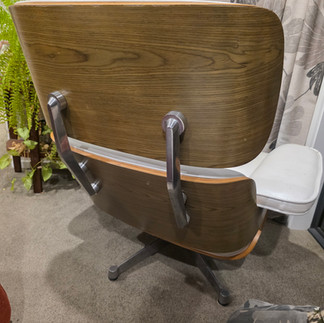


Identifying Your Treasure
Based on details, we have a high-quality vintage production, likely from the 1970s–1990s.
7-Layer Shell:
While early 1950s models had 5 layers, the 7-layer plywood became the standard for increased durability starting in the early 90s.
The "Floating" Back:
The absence of visible screws on the back shells indicates our chair uses internal shock mounts. This premium construction allows the chair to "flex" without drilling through the wood grain.
Hardware:
The use of two Phillips-head screws under the armrests identifies this as a "Second Series" style, used consistently from 1960 until the move to hex bolts in the mid-2000s.
Originals vs. Replicas
Only two companies are authorized to produce the chair using the "Eames" name: Herman Miller (USA/NZ) and Vitra (Europe). Because the design is so iconic, it is one of the most copied pieces of furniture in history. While lower-end replicas use visible bolts and 4-star bases, high-quality "heritage" replicas aim to match the original 7-ply shell and internal shock mount engineering.
The ReCycle ReCreate Touch
The seat is a little "hard" is a classic sign of aged urethane foam compressing over decades. By layering an orthopaedic cushion and a long-pile sheepskin, we've practiced exactly what Charles and Ray preached: using natural, human-centred textures to make high design work for real life.
Restoration at some point in the future
At the current moment we are happy with how this piece is as no major damage, cuts, scratches or holes. Just one missing button and some natural wear.
Compared to buying a new replica, restoring would be a winner. As we have already secured the most important part: a high-quality, 7-layer frame with internal mounts for a fraction of its value. Using local Canterbury craftsmen and New Zealand hides turns this bargain into a lifelong, sustainable masterpiece for our home.
Using local better grade leather, it will exceed what is found on mid-range modern replicas and last longer. Our chair may require replacement leather and foam plum up, the cost to get this done professionally could be between $800 and $1500, and whilst not cheap, the final product is a "new " vintage chair with a much higher resale than a replica.
Modern replicas vary in quality
Convenience: You get a "perfect" looking chair immediately with fresh foam and no structural worries.
Price Point: A decent replica in NZ typically ranges from $800 to $2,000.
Material Risks: Lower-end replicas often use "top grain" leather that is heavily corrected or even "bonded" leather, which can peel or crack much faster than high-quality NZ hides.
Construction Differences: Many new replicas under $1,000 use bolts through the back of the wood shells rather than the internal shock mounts your current chair has, which changes the iconic "floating" look.
Looking for your own original, here is your guide for spotting a vintage gem for less!
Herman Miller Eames Lounge Chair Thrifter's Checklist
Details that matter | Red Flags (Replica/wear) |
7 Layer Plywood - check the shell's edge for 7 distinct layers | 9+ plywood layers |
Internal shock mounts - no visible screws on the back "floats" | Visible bolts/screws - bolts drilled through the back of the wood shells |
Look under arm rests for type of bolts and number | 4 - Star base - Ottoman has 4 legs, original chair has 5 (watch for 4-star bases) |
Tan Zipper tape - inner fabric of cushion zippers should be tan or beige | White/black zippers - plastic zippers with white or black fabric tape |
When we first started looking we could only find very expensive new or second-hand replicas. Both around similar pricing. We kept looking and missed out on a cheap but damaged one (in hindsight was a good thing). Then we found this one at an even lower price! Second hand shopping is all about patience, persistence and timing. They say good things come to those who wait...
The Final Discovery:
Identifying a "Stealth" Vitra Just when I thought the story of my "bargain icon" couldn't get more interesting, the physical evidence started pointing toward a very specific origin. While Herman Miller is the name most Kiwis know, my chair bears the unmistakable "fingerprints" of Vitra—the exclusive authorized manufacturer for Europe and the International market since 1957.
Finding an authorized Vitra in rural Canterbury for the price of a few pizzas is a testament to the value of choosing quality over mass-produced clutter. It turns out that when you look for "forever" engineering, the labels don't even matter—the craftsmanship speaks for itself.
The "Smoking Gun" Evidence
The most technical discovery was under the armrests. I noticed the mounting screws were spaced significantly wider apart than the Herman Miller versions I saw in research videos. This wider stance is a signature Vitra engineering choice, designed for increased lateral stability. When combined with the non-swivel ottoman—a famous Vitra-only design rule—the mystery was solved.
Comparison: My "Stealth" Vitra vs. Herman Miller Feature
Feature | My Vitra Findings | Herman Miller (Standard) |
Armrest Screws | Wide-set spacing for extra stability | Screws are positioned much closer together |
Ottoman Base | Fixed / Non-swivel (A Vitra signature) | Traditionally designed to swivel 360° |
Leg Profile | Thicker, industrial matte aluminum casting | Often a slimmer, polished/painted profile |
Plywood Shell | 7-layer construction (The 90s standard) | Varied by era (Originals were 5-layer) |
Metal Finish | Brushed Matte Aluminum (Hides wear) | Often features polished tops with black sides |
Why This is a "ReCycle ReCreate" Masterpiece
Because this is a Vitra from the mid-to-late 1990s, it was built during a "sweet spot" of design—retaining the classic hardware but upgrading to the 7-layer shell for modern durability. It isn't a "knockoff" that will end up in a landfill; it’s an authorized piece of art that we can now restore with NZ leather to last another 30 years.
The Great Swap: Out with the clutter, in with a bargain Icon.
Many years ago I bought a second hand green leather lounge suite. Our recliner was well used and had split in the head rest. So I patched and used it until it was time to go. The rest of the lounge suite (1 more recliner and 3 seater couch are still in very good condition). Since we have just added our Eames lounge chair to the family, we had decided to retire the damaged recliner.
Before doing this, I did some research on the lounge suite and the leather especially. I discovered that Rubelli is a name steeped in Italian history, dating back to 1858 in Venice. They are known for 'artisanal care' and using high-quality hides that are designed to last for decades.
My suite featured Grade 35 real hide, which explains why, even after all these years, the leather is still so substantial.
Rubelli recliners were built as "forever furniture," often featuring coiled sprung seat foams and heavy-duty metal mechanisms, which explains why the rest of our suite is still in such great condition despite years of use. This is exactly why I couldn't just throw it away. In the spirit of ReCycle ReCreate, hubby spent the the afternoon yesterday dismantling the recliner. The high-quality metal parts are heading for recycling, but the real treasure is the large panels of thick, green Italian leather. These have a beautiful patina that only comes with age, and I’m already planning to transform them into bespoke leather bags—a perfect, sustainable project to celebrate the arrival of our new vintage Eames chair. Keep an eye out for future updates on our Facebook page for the leather bags.





What both these pieces—the retired Rubelli and the new Eames—prove is that quality outlasts mass production every time. We’ve learned that you don't need a huge budget to furnish a home with high-end pieces; you just need the patience to wait for the right one to turn up. By choosing a pre-loved 'bargain icon' over a cheap, modern alternative, we aren’t just saving money—we’re investing in craftsmanship that has already stood the test of time and is ready for another 30 years of life.
It’s about choosing substance over shortcuts and realizing that the perfect, sustainable piece is always worth the wait
A Note on Authenticity: Part of the joy of "Recycle Recreate" is the hunt! While I use industry-standard markers (like ply-count and hardware) to identify vintage pieces, please note that I am a passionate upcycler, not a certified furniture appraiser. I encourage all readers to do their own deep-dive research when evaluating high-value thrift finds.
Disclaimer: "Eames" is a registered trademark of Herman Miller, Inc. and Vitra. This blog is not affiliated with, endorsed by, or sponsored by Herman Miller or Vitra. All mentions of "Eames-style" refer to the iconic aesthetic of the design and are intended for historical context and comparative identification purposes.


Comments